
In 2018, just 4,000 properties across Staffordshire could access gigabit-capable broadband. By last summer, that figure had climbed to more than 372,800, a near-hundredfold increase in seven years achieved six months ahead of the county’s own target. Staffordshire now has gigabit coverage across 86% of its properties, putting it ahead of comparable counties. For businesses in Tamworth, that is not a minor infrastructure footnote. It is the kind of improvement that changes what is practically possible day to day.
Behind this progress sits the UK Government’s Project Gigabit programme: a national initiative that has directed nearly £47 million into Staffordshire alone, specifically to reach communities that commercial providers would not otherwise serve. The long-term ambition is for 99% of UK premises to have access to a gigabit-capable connection by 2032. For businesses in Tamworth and the surrounding area, the question is no longer whether the infrastructure will arrive. It is what to do with it once it does.
What gigabit broadband means for your business
The term “gigabit broadband” refers to a connection capable of download speeds of at least 1,000 megabits per second, which is roughly 30 times faster than the minimum threshold for a standard superfast connection. More importantly for businesses, modern full-fibre connections (FTTP – Fibre to the Premises) deliver symmetrical speeds: upload matches download. That distinction matters more than most people realise, because the tools businesses now depend on are constantly sending data in both directions.
Most traditional business tasks – emailing, browsing, basic file sharing – do not require gigabit speeds. But the way businesses use technology has shifted considerably. Cloud platforms, video collaboration, data-heavy applications, and AI-powered tools all place sustained, simultaneous demands on a connection. An accounting firm with five staff running Microsoft 365, a shared cloud drive, Teams calls, and a cloud-based practice management system is drawing on its connection constantly. When bandwidth is tight, those systems slow down, calls drop, and file syncing creates queues. Gigabit connectivity removes that constraint – though the line speed is only part of it.
The technologies that faster connectivity makes viable
The practical benefits of faster broadband show up most clearly in the tools it finally lets businesses use properly – without workarounds. Cloud computing platforms such as Microsoft Azure, Google Workspace, and AWS have become standard infrastructure for businesses of all sizes, but their performance depends heavily on the quality of the connection feeding them. A slow or inconsistent line can make cloud-hosted software frustrating enough that staff route around it by keeping local copies of files, skipping cloud backups, or working offline. Ultimately, this defeats the purpose of migrating to the cloud in the first place.
The UK Government’s SME Digital Adoption Taskforce set a specific target in its 2025 final report: for the UK to become the most digitally capable and AI-confident economy in the G7 by 2035. Cloud tools, CRM platforms, and AI-powered software are the means. Gigabit broadband is the precondition. For businesses in Tamworth – many of which operate in manufacturing, engineering, food distribution, and professional services – that connection between infrastructure and technology adoption is worth taking seriously now, not in five years.
AI-powered tools are increasingly available as affordable, off-the-shelf products. All within reach for an SME – a manufacturer flagging anomalies in production data, an engineering firm running automated document review, a professional services business using AI-assisted scheduling. None of them work well on a connection that can’t keep up.
The part of the conversation that often gets skipped
Gigabit broadband arrives at a building’s external connection point. What happens to it once it’s inside is a separate question entirely, one that gets less attention than it should.
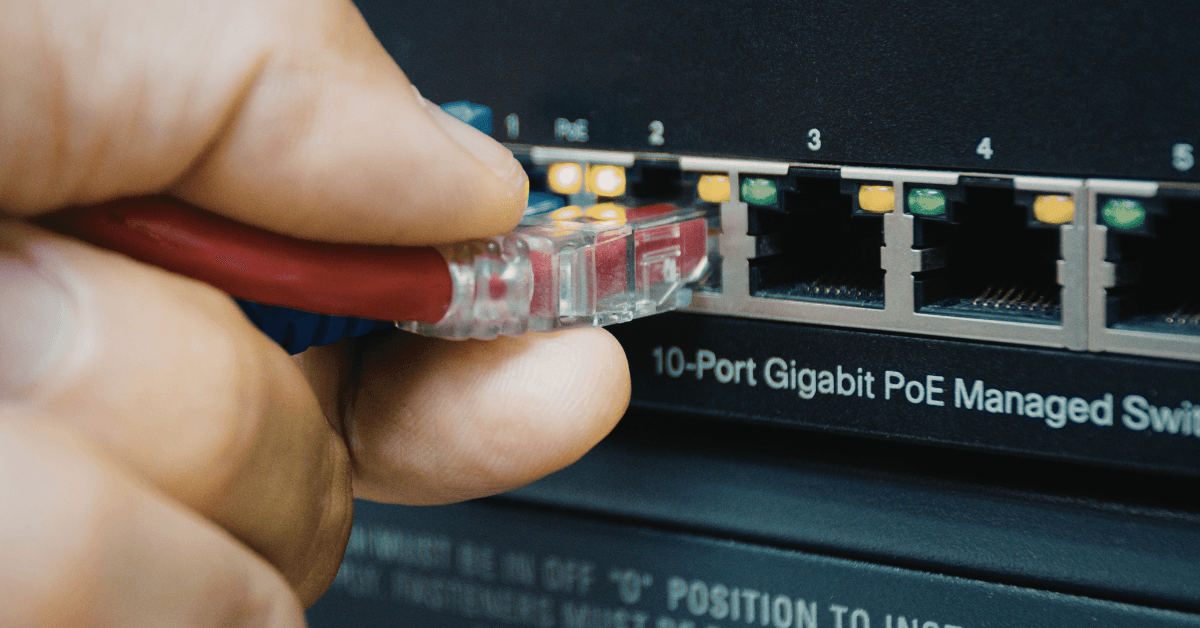
An older internal network switch, ageing Wi-Fi access points, or a router that predates modern standards can throttle a gigabit connection down to a fraction of its potential before the signal reaches a single device. A business that upgrades its broadband line but leaves its internal network infrastructure untouched will often see little tangible improvement in day-to-day performance. The external pipe gets bigger, and the internal plumbing stays narrow.
This is something we see regularly. A business moves to a faster line, the improvement is less dramatic than expected, and the assumption is that they’ve been oversold. Usually, the issue is that the internal network was installed years before those speeds were commercially available and was never designed to handle them. A proper end-to-end review, from the connection point through to the devices people use, is the only way to be confident the upgrade is delivering what it should.
Faster connectivity, bigger attack surface
Faster broadband gets a lot of attention. The question of what sits behind it, less so. As businesses move more of their operations online – more cloud platforms, more connected devices, more external suppliers with access to internal systems – the number of potential entry points for an attacker grows alongside it.
The government’s Cyber Security Breaches Survey 2025 found that 43% of UK businesses experienced some form of cyber security breach or attack in the past twelve months. Among medium-sized businesses, that rises to 70%. Ransomware incidents, where attackers encrypt systems and demand payment to restore access, doubled year-on-year, from under 0.5% of businesses in 2024 to 1% in 2025, affecting an estimated 19,000 organisations.
Gigabit broadband accelerates the move toward cloud-based and digitally connected operations, and any business taking that step needs its cyber security keeping pace. Firewalls, multi-factor authentication, secure remote access, and staff awareness training are not things to schedule for later once the new connection is up and running. Deferring them is a false economy.
Getting the most from the infrastructure around you
For businesses in Tamworth, the broadband infrastructure question has largely been answered. Whether you’re a manufacturer in the surrounding industrial areas, a professional services firm in the town centre, or a distributor with multiple sites across Staffordshire, the fast, reliable connectivity that underpins cloud adoption and digital tools is now available or arriving.
What is less automatic is making sure everything else is ready for it. That means checking your internal network can distribute the speeds arriving at your door and reviewing your cyber security before you expand your digital footprint. It is much easier to do those things in sequence when you’re working with an IT team that understands how the connection, the infrastructure, and the security layer interact, rather than treating each as a separate job.
Faster broadband is not the destination. It is what becomes possible once everything behind it is set up properly.
Want to know whether your business is ready to make the most of modern IT infrastructure? Visit our contact page to speak with our team.
Frequently Asked Questions
What is external penetration testing?
External penetration testing is a controlled security assessment that evaluates how attackers could access your systems from outside your organisation.
Why is external penetration testing important for Birmingham businesses?
Local businesses rely heavily on internet-facing systems and remote access. Testing helps identify weaknesses before they are exploited and supports due diligence.
How often should penetration testing be carried out?
Many organisations choose annual testing, with additional assessments following major system changes or new service deployments.
Will penetration testing disrupt our business?
Professional testing is carefully scoped to minimise disruption while still providing meaningful insight into security risk.
Is penetration testing suitable for small and medium-sized businesses?
Yes. Smaller organisations are frequently targeted due to limited visibility of risk. Penetration testing helps level the playing field by identifying exposure early.
